Late 2025 / early 2026
formal adoption by the Council and Parliament


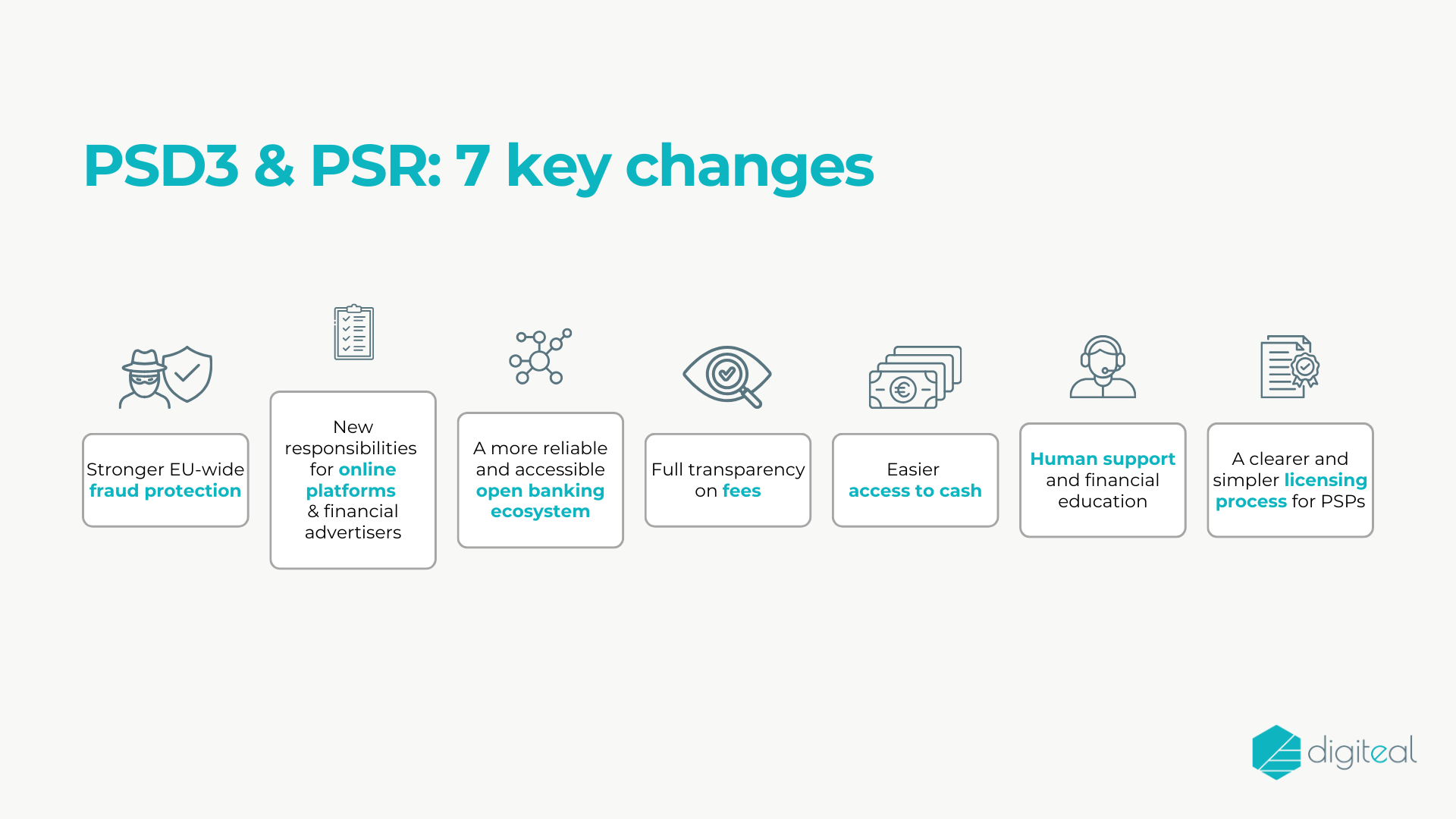
The agreement introduces a series of important new obligations.
Payment service providers will need to verify whether a beneficiary’s name matches the IBAN before a transfer is executed. If it does not match, the PSP must reject the payment and inform the user. This has been added already in the Instant Payment Regulation (IPR) that came into force on 09/10/2025. It proves that EU regulation can be decisive and quick to establish new measures to combat fraud.
Digiteal already provides a Verification of Payee API that enables PSPs, payment platforms and all other organizations to meet this requirement efficiently.
Payment service providers will have to exchange fraud-related data so suspicious patterns can be identified earlier.
PSPs must offer customers the ability to set spending limits and block payment methods to reduce the risk of fraud.
Any transaction manipulated or initiated by a fraudster will be treated as unauthorised. The PSP must reimburse the full amount.
This mechanism strengthens detection and prevents suspicious funds from being moved too quickly.
If a criminal pretends to be the customer’s bank or PSP and tricks them into approving a payment, the PSP will have to refund the victim once the fraud is reported to the police.
These measures create a more consistent and much stricter fraud-management framework across the EU. The modalities of this will be important to correctly define in the upcoming regulatory technical standards (RTSs) linked to the PSR not to put unrealistic constraints on PSPs.
Online platforms will be liable towards PSPs when they have been notified of fraudulent content (fake ads, fake merchants, phishing pages…) AND they fail to remove it.
Financial advertisers will also need to prove to large online platforms and search engines (VLOPs and VLOSEs) that they are legally authorised to offer the services they promote.
This builds on the Digital Services Act and further protects consumers in the digital space.
To make open banking work better in practice, the PSR introduces:
In addition to this, mobile device manufacturers and electronic service providers must allow apps and interfaces to store and transfer the data needed to process payments, on fair and reasonable terms. This ensures that payment innovation is not blocked by hardware or software restrictions.
PSD3 and the PSR cover the entire payments value chain: (neo)banks, payment institutions, fintech companies, payment gateways, card processors, e-commerce platforms, marketplaces, retailers offering cash withdrawals, device and operating system manufacturers, crypto-asset service providers…
If you process payments or handle payment data in any way, this reform concerns you.
The agreement reached is provisional and still needs technical work before formal adoption. Therefore, the following timeline is indicative.
For businesses, this means that the first operational impacts could arrive as early as 2026.
You will need to ensure that your payment partners:
Key workstreams include:
PSD3 and the PSR represent a major step forward for payments in Europe. By combining stronger anti-fraud measures, clearer responsibilities, better transparency and a more functional open banking ecosystem, the EU is building a safer and more user-friendly environment.
For payment providers and businesses, this is both a challenge and an opportunity. A challenge because compliance efforts will be significant, and an opportunity because trust, security and transparency are decisive differentiators.
At Digiteal, our mission has always been to make payments and financial processes simple, secure and fully compliant. As a PSD2-licensed Payment Institution (PI), we support organisations in managing payment flows and electronic invoicing connectivity in line with the latest European standards. We will apply the changes required to become one of the first PSD3 payment institutions in Belgium just as we were one the first PSD2-licensed PI.
If you would like guidance on how PSD3 and the PSR may impact your organisation, we are here to help.
COMPANY
Digiteal SA
BE 0630675588
LEI 9845000A44AB9CA60605
Rue Emile Francqui 6/9
1435 Mont-Saint-Guibert
Belgium
ABOUT DIGITEAL
 Scroll to top