Marketplace Payments:
All you need to know

Zoom on marketplaces

In this comprehensive article dedicated to marketplace payments, you will find detailed information on their business model, advantages, possible payment methods (e.g. Split & Merge), and the importance of staying vigilant when it comes to securing these payments via a PSP (Payment Service Provider) such as Digiteal.

What is a marketplace?

The definition of a marketplace is “any store, physical or online, that facilitates the exchange of goods between buyers and sellers”.

There are two main types of marketplaces:

  • Horizontal

    horizontal-type marketplaces are the most common, bringing together a very large number and variety of products. Amazon comes to mind here, as a very generic marketplace. The more product categories there are, the more likely you are to find what you’re looking for, and therefore, the more sales opportunities for marketplaces. Competitive prices are also a great incentive for impulse buying.

  • Vertical

    in contrast, vertical marketplaces sell only products related to a single category. As such, these marketplaces only attract a well-informed audience, and are perceived as experts in their field. For example, Etsy for handmade/DIY goods, or Airbnb for short-term home rentals.

Marketplace and eCommerce websites: what is the difference?

Marketplaces and e-Commerce websites are not the same thing: they don’t operate according to the same model, even though they are both designed to sell on the Internet, which can lead to confusion. A marketplace collects funds from third parties for sellers who have previously registered with the marketplace. An e-Commerce business, on the other hand, directly collects the amounts paid by customers, without redistribution.

Responsibility is also different. The marketplace brings buyers and sellers together and facilitates purchasing, but is not responsible for the products or services sold: this responsibility lies with the seller. E-commerce is offered directly by a seller, who assumes full responsibility.

Marketplace Payments Digiteal

What is the marketplace business model?

A marketplace generates revenue by charging a commission on each transaction carried out on its platform. This commission may be fixed or based on a percentage of the transaction amount

Moreover, some marketplaces may also offer additional services for a fee, such as advertising or product showcasing. The main aim of a marketplace is to facilitate exchanges between buyers and sellers, while generating revenue from the transactions carried out on its platform.

Notoriety

Ideally, the marketplace should enjoy a certain notoriety and gradually become a reference point for buyers, or even something automatic.

Delivery fees

Purchase-related costs, such as delivery charges, may also be offered if the total amount of your order exceeds a certain sum.

Commercial strategy

To increase customer (and target/prospect) loyalty, special promotional programs are set up to reward loyal customers (VIP program and/or points collection).

Navigation

The marketplace’s excellent ergonomics (UX) is also a very important point differentiating it from the increasingly tough competition. The various options and paths on the website, such as the customer journey, must be clear and efficient to avoid customers abandoning their shopping carts…

Why are marketplaces so popular today?

Over the last ten years or so, we’ve seen the emergence of a host of different marketplaces in a variety of sectors (retail, fashion, automotive, catering, etc.), such as Vinted, Etsy, Cdiscount, Uber, Ankstore and others. 

This business model is becoming increasingly popular, thanks to the proliferation of new marketplaces. Marketplaces have several competitive advantages:

  • Wide choice of products

    marketplaces offer a wide range of products from different sellers, giving consumers a wide selection and making it easy to find what they’re looking for.

  • Convenience

    marketplaces offer a convenient shopping experience, enabling consumers to find and buy products in one place, without having to navigate different sites.

  • Trust and security

    marketplaces often establish buyer protection policies, such as money-back guarantees or seller rating systems, which reinforce consumer confidence.

  • Opportunities for sellers

    marketplaces offer sellers increased visibility and access to a broad base of potential customers, which can boost sales and growth.

  • Price comparison

    marketplaces enable consumers to easily compare the prices of products offered by different sellers, promoting transparency and competition.

How do payments for marketplaces work?

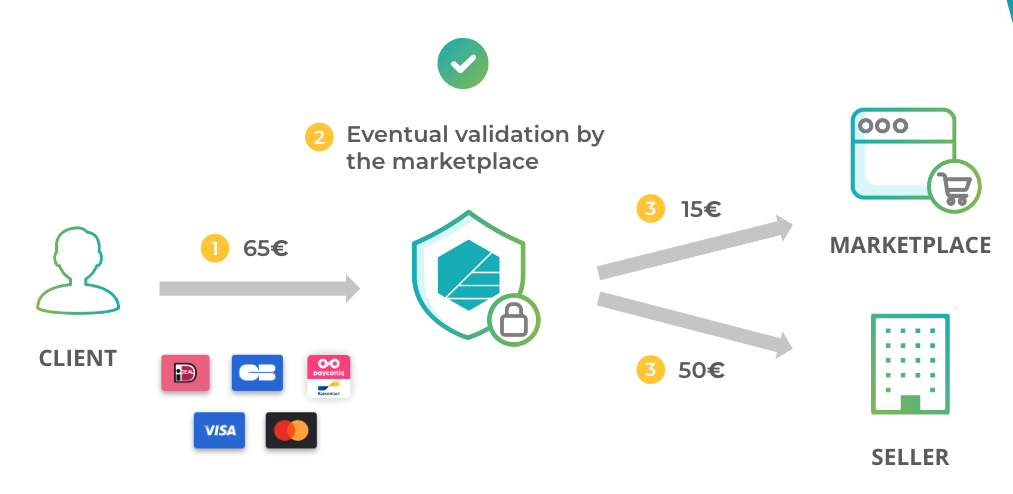
  • 1

    Payment process

    when a buyer makes a purchase on a marketplace, he or she selects the desired product and proceeds with payment. The marketplace facilitates the payment process by providing a secure interface to complete the transaction.

  • 2

    Payment options

    marketplaces often offer several payment options, such as credit cards, e-wallets or bank transfers. This allows buyers to choose the payment method that best suits them.

  • 3

    Payment management

    once the buyer has made the payment, the marketplace ensures secure management of the funds. It holds the payment until the transaction is confirmed and the product is delivered, thus protecting the buyer.

  • 4

    Commission

    the marketplace charges a commission on every transaction. This commission can be directly charged to the buyer, or invoiced separately to the seller. Digiteal enables this to be automated.

  • 5

    Payment to sellers

    once the transaction has been finalized and the product successfully delivered, the marketplace transfers the funds to the seller, after having deducted the applicable commission.

Marketplace Payment Model

What invoicing methods are used on a marketplace?

There are two invoicing options

Directly on the marketplace

The marketplace issues the invoice in its own name, and is therefore responsible for warranty, service, etc., towards its customers. In this case, the marketplace can collect the funds into its own bank account. Strictly speaking, it is no longer a marketplace, but a reseller.

On a third-party account

If the invoice is issued in the seller’s name, the money cannot be collected via the marketplace’s bank account. It is legally required to use an escrow account, a “third-party account”. And this is precisely one of the services offered by Digiteal, in its capacity as a payment institution authorized by the National Bank of Belgium.

With an authorization to operate on a European scale, Digiteal provides you with an escrow account in order to be 100% compliant with legislation. Our Fintech adds even more value, as it enables you to collect a single payment (pay-in) and automatically distribute this sum between the marketplace and the seller(s) concerned.

Are marketplace payments secure enough?

While users are always advised to use caution, such as verifying the seller’s reputation and using secure payment methods, fraudsters are becoming increasingly inventive

Payments on marketplaces are (generally) secured through the services of a PSP (Payment Service Provider), which has a third-party account. A Payment Service Provider (PSP) is a so-called third-party company that enables businesses to accept electronic payments, such as credit or debit card payments. PSPs act as intermediaries between those who make payments, i.e. consumers, and those who accept them, i.e. retailers/vendors.

These PSPs offer secure payment solutions through various methods such as data encryption, user identity verification and fraud protection. They also facilitate transactions by providing various options and managing refunds, if required.


Digiteal as a payment facilitator for marketplaces

Digiteal is a payment facilitator (Multi-PSP), a company that provides the necessary infrastructure for merchants to accept payments. Merchants register and benefit from the technology needed to process electronic payments and receive the related funds.

To provide these services, Digiteal relies on acquirers who are directly connected to the payment schemes to collect the funds. The funds are then transferred to escrow accounts managed by Digiteal, allowing them to be paid out to merchants.

Les paiements marketplaces avec Digiteal - Marketplace payments with Digiteal

What about my personal data?

Digiteal complies with personal data protection legislation as established by the GDPR and is additionally ISO 27001 certified, an international information security standard. 

Would you like to integrate innovative payment solutions into your marketplace?