Peppol Access Point: Definition,
How to Choose Yours

If you’re a business owner, public administration official, or an integrator, you may have heard of  Peppol Access Points.

But what is it exactly? What are the benefits? What criteria should you pay attention to when choosing your Peppol Access Point? Read on to find an answer to all your questions.

e-invoicing PEPPOL

What is a Peppol Access Point?

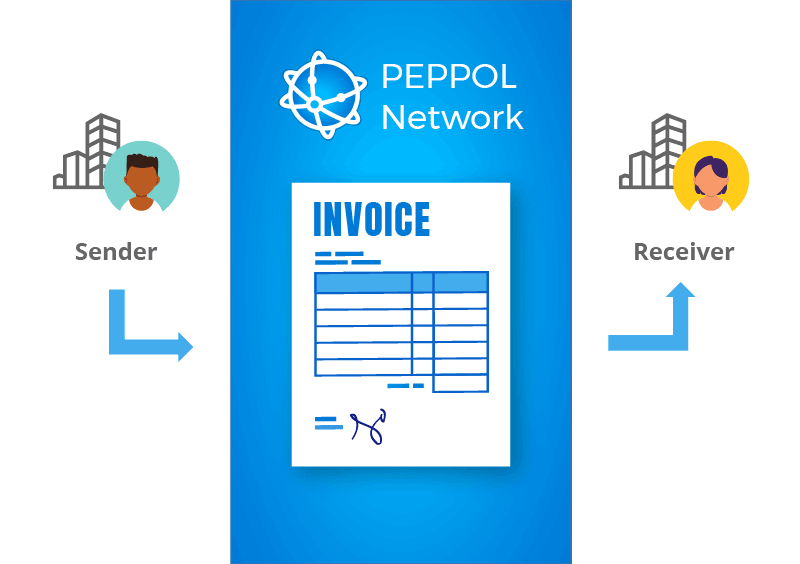
A Peppol Access Point is an organization that enables companies and public administrations to connect with the international Peppol network. This connection allows them to securely and reliably exchange electronic invoices.

The Peppol network can be compared to a telephone network.

In the Peppol network:

  • the phone carriers are the Peppol Access Points
  • the phone numbers are the Peppol IDs
  • the phone conversations are by default exchanged as UBL messages which must be understood by all carriers ; however, you can exchange other types of messages (if both parties support them, if the format is declared in their respective Service Metadata Publisher (SMP) and if the Peppol Access Points involved support that specific format)
  • the public switch network (PSTN) used to interconnect the phone carriers is based on the AS4 standard
  • the phone book is the Peppol Directory
  • the phone registry used by the carriers to route the traffic is the Service Metadata Locator (SML)
  • the users of the network are Peppol participants.

So, the role of the Peppol Access Point is to provide to Peppol participants access to the Peppol network to send and/or receive messages. The principles that they must abide by are managed by the OpenPeppol association that delegates the governance to Peppol authorities. There is usually one Peppol authority per country.

Apart from the connectivity aspect, the Peppol Access Points must also check the validity of the messages sent over the network.

Peppol Access Point @ Digiteal in Belgium

What are the benefits of a Peppol Access Point?

Common benefits

  • Automation: Electronic Ordering and Invoicing are instrumental to provide the full automation of the Order-to-Cash and Procure-to-Pay processes. Since these processes are conducted by different parties, these parties need to communicate efficiently together. This communication is enabled by the Peppol Access Point.
  • Standard: Many networks are available to enable this like Tungsten, ARIBA, Tradeshift, etc… Though they have been quite successful, they rely on different private protocols and it is very complicated to reach interoperability.
  • Lower cost: The proprietary networks lead to a high operating cost since they are privately operated giving to the owner the capacity to set the prices. To reduce the cost of the network, OpenPeppol is based on open standards with no interconnect fees between the Access Points. Because this is an open network, more than 500 Peppol Access Points are competing throughout the world to provide commodity connectivity services. This greatly reduces the cost and gives Peppol participants the freedom to easily switch Peppol Access Point if they would not be satisfied with the quality of the service or the price.
  • Up-to-date: The Access Points informs the billing softwares of the participants of updates in the standard it must comply to and greatly limits the impact of the changes.
  • Mandatory: Peppol is mandatory in many countries in B2G with B2B and B2C set to also become mandatory in the coming years following schedules already set out or that will soon be as you will read this.”In Belgium, for example, the use of Peppol for B2B invoicing will become mandatory starting January 1 2026. To summarize, there is an important need linked to automation, it does not cost much and Peppol is the obvious choice because it is a mandatory standard.

B2B companies find solutions by Digiteal

Benefits as a company

  • Mandatory: Companies must use Peppol to send invoices to public authorities (B2G) in many countries (like BE and LU). To do so, they need an Access Point
  • Outsourced: Operating their own Access Point is expensive and the cost of exchanging documents through competitive Access Points (like Digiteal) is very low (maximum 0,10€ per document, 0,04€ if 100.000 documents are sent per month).
  • Faster collection: Companies get paid faster because the invoices they are sending are processed more efficiently by their customers.
  • Cost reduction: Companies reduce their cost to handle both outgoing and incoming invoices through automation.

Public administrations find solutions by Digiteal

Benefits as a public administration

  • Mandatory: Public administrations must receive invoices through Peppol. They need an Access Point to enable this. In Belgium, this Access Point is provided by BOSA and it is called Mercurius. Digiteal enables an integration through Mercurius too so that they can keep their current Access Point while having a ready to use API to handle both Peppol and Mercurius integrations.
  • Efficient: Without an end-to-end integration, the invoice received by the Access Point might be sent out through email or even printed leading to no gain for the public administration. The connectivity to the Access Point is paramount to achieve the gains linked to automation.

Integrators find solutions by Digiteal

Benefits as an integrator or software developer

  • Mandatory: The companies and public administrations are using software to enable sending and receiving invoices. This software must be able to connect to the Peppol network.
  • Fast integration: Through simple APIs, Access Points can greatly reduce the time for an ISV (independent software vendor), an integrator and a software developer to add the necessary Peppol connectivity.
  • Reduced Cost: Instead of developing and maintaining their own Access Point, it is much more cost effective to use the services of an existing Access Point.

Criteria to choose your Peppol Access Point?

Finding the Access Point that suits you best is not necessarily easy. We recommend that you consider the following six criteria to help you make your decision:

APIs

Easy to use, well documented and up-to-date APIs are very important to reduce the time necessary to connect to Peppol.

Completeness

The APIs must cover the full lifecycle including the registration of participants, their re-registration, the sending and the receiving of documents.

Realtime

We live in a realtime world and it is important that the provided interface provide realtime feedback. Many vendors will provide batched processing of invoices which are cumbersome and time consuming to manage and get proper reporting on.

Allowed document type

With attachments contained in the documents, it is important that the Access Point does not restrict the document size too much.

Up-to-date

The Access Point must provide an up-to-date service using the latest technologies and the latest versions of the validator to properly respect the standard and avoid having your document rejected by the recipients because your sending Access Point did not properly validate them.

Focused on open-standards

The best Peppol Access Points focus on open-standards and provide what should be a commodity solution at the best possible price. Access to proprietary networks should be the exception to keep the costs low and avoid unnecessary complications.

What about Peppol APIs?

Peppol API

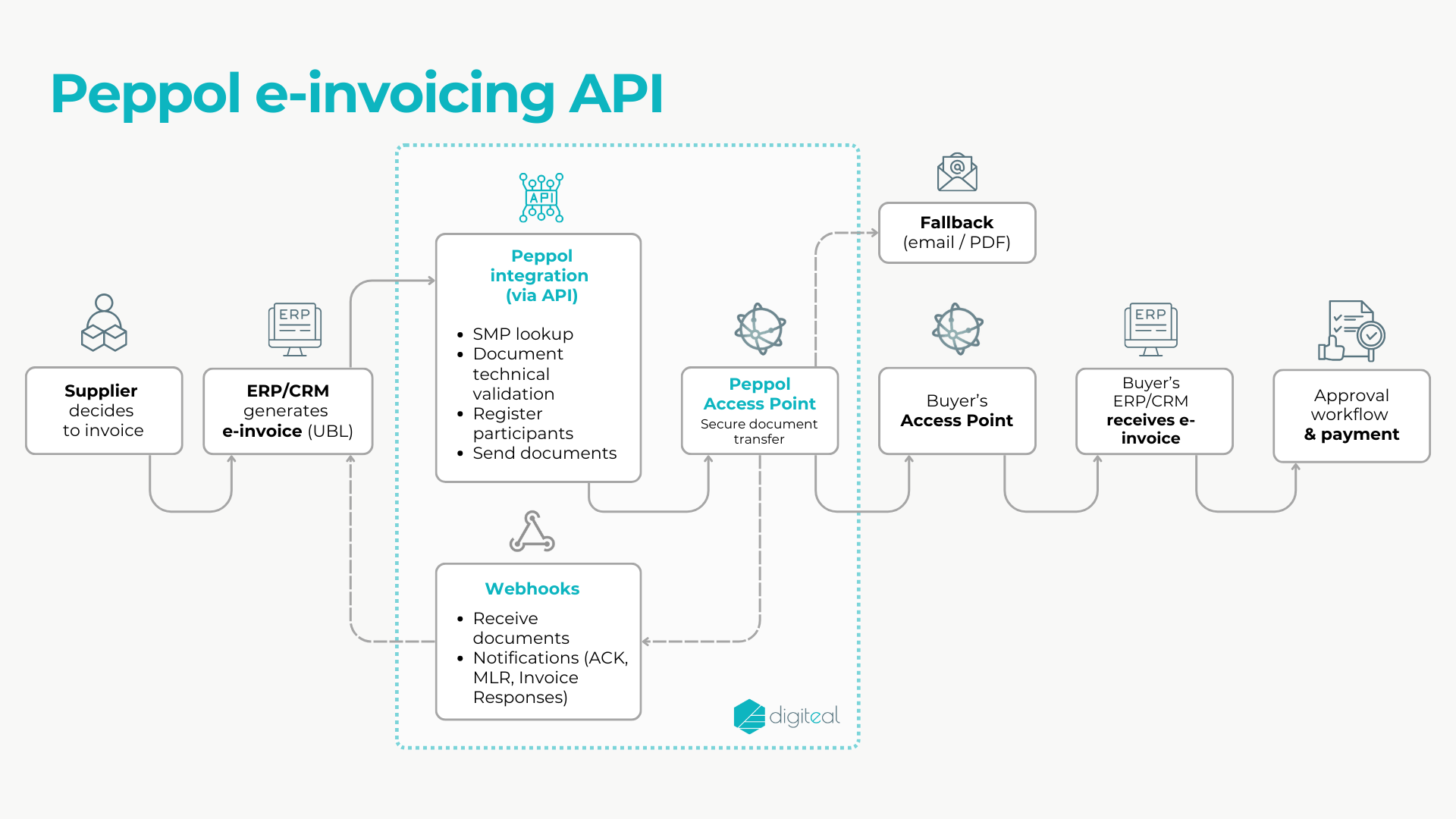
A Peppol API is the technical interface that allows your software (ERP, accounting or invoicing tool…) to connect directly to the Peppol network without managing the underlying complexity yourself. In other words, it abstracts the technical layers of the Peppol infrastructure (AS4, SML, BIS Billing, etc.) so you can propose a modern interface to register participants, send and receive documents and track invoicing status in real time (thanks to MLRs and Invoice Responses).

Instead of dealing internally with multiple certificates, formats and evolving standards, you integrate once with your Peppol Access Point API, and the Access Point takes care of compliance, validation and transmission across the Peppol network. It’s the easiest way to make your software Peppol-ready without rebuilding or rethinking your stack.

Compliance and security

To be certified and authorized to operate, Peppol Access Points must be managed by service providers who comply with strict requirements defined by OpenPeppol and national authorities.

To protect the integrity and confidentiality of your documents, they must also enforce end-to-end encryption, use the AS4 messaging protocol and have their information security processes certified under ISO 27001 (for information security management).

A compliant Access Point also makes sure that your documents are validated, routed to the correct recipient and archived when necessary. They should demonstrate that they are performing the service end-to-end with no changes in the documents being exchanged and full auditability. They should finally have a robust infrastructure to deliver the service 24/7 with a strict SLA.

How to migrate from one Peppol Access Point to another

One of the strengths of the Peppol network is that it is open and provider-agnostic. You are never locked in. If you are unhappy with the cost, the quality of support or the API of your current Access Point, you can change anytime. The process is even simpler than you might think!

Migration process:

Good to know:

  • No action is required from your customers or suppliers: your Peppol ID remains the same.
  • Not satisfied? You can switch back anytime. Peppol is a competitive ecosystem.

Should you build your own Peppol Access Point?

Some large organizations might consider setting up their own Peppol Access Point. It’s a tempting idea: internalized infrastructure, autonomy, full control… But in practice, the road is long, complex… and expensive, of course.

To operate your own Access Point, you MUST:

  • Become a member of OpenPeppol and sign the Transport Infrastructure Agreement (TIA)
  • Undergo conformance testing to validate compatibility with the Peppol specifications
  • Be certified under ISO/IEC 27001
  • Maintain 99,5% SLA availability
  • Constantly keep up with protocol updates (BIS Billing 3.0 and soon BIS 4.0)
  • Implement and host the AS4 messaging stack

On average, the full process takes 3 to 6 months (depending on your budget and whether you already have a team of Peppol-savvy developers). And once you are certified, you still have high ongoing cost to maintain your infrastructure through internal expertise.

By contrast, outsourcing Peppol connectivity to a certified Access Point like Digiteal only takes a few days. And the result is the same: 100% Peppol-compliant and secure document exchange.


Enjoy all Peppol benefits with Digiteal

  • The APIs of Digiteal are available here. They are very easy to use and provide all you need to connect to Peppol.

  • The Peppol service of Digiteal operates in realtime. When registering a participant or sending a document, this is executed immediately and you also immediately have the confirmation it was successful.

  • Digiteal allows for documents up to 25MB to make sure that even if they need to be sent by email from the receiver’s Access Point that they will be delivered.

  • Digiteal provides a way to be informed of future validations that will be performed so that you can anticipate them and never be surprised by a standard upgrade that would impede your systems.

  • Digiteal provides a Peppol solution and does not provide access to proprietary networks. We are focussed on delivering the best open-standards solution.

Would you like to have more information about our Peppol services?