COMPANY
Digiteal SA
BE 0630675588
LEI 9845000A44AB9CA60605
Rue Emile Francqui 6/9
1435 Mont-Saint-Guibert
Belgium
ABOUT DIGITEAL


Open Banking APIs allow consumers to securely share their financial data with authorised third-party providers (TPPs), enabling them to access new financial products and services. These APIs help to create a more open, transparent, and competitive financial services market by giving consumers greater control over their financial data and empowering them to make more informed financial decisions.
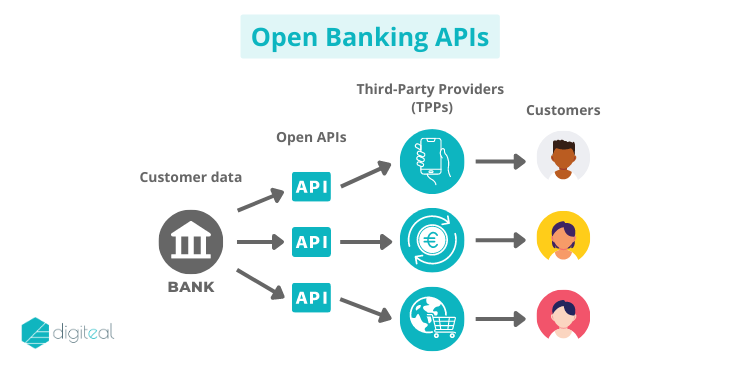
Open Banking in Europe is enabled by the EU Payment Services Directive (PSD2) regulation that came into effect in January 2018. This regulation increases competition and innovation in the banking industry by providing consumers with greater control and access to their financial data. It requires banks to open up access to their customer data through APIs and allows Third-Party Providers (TPPs) to offer payment and financial services with the customer’s consent.
Prior to the advent of PSD2, your financial data was only available to your bank. If you wanted to export this data to use it somewhere else or initiate a payment, you were only able to do it yourself through bank controlled channels. Banks were a fortress and your data was locked inside leading to poor interoperability and you could only use the services that your bank was providing you.
With PSD2, the bank account holder can give access to the fortress by giving his consent to TPPs. This opens a multitude of solutions developed throughout Europe and that the customer can now make use of whichever bank holds his account.
This regulation has enabled the development of new financial and banking services, such as comparison websites and personal finance management tools and has helped increase consumer transparency and security.
Using APIs enables faster and more secure data transfers between financial institutions, reducing the risk of fraud and improving the overall user experience. Using standardised APIs also helps promote innovation and competition in the financial sector by enabling the development of new services and applications that can be easily integrated into existing banking infrastructure.
In summary, Open Banking APIs drive innovation, increase competition and empower consumers to make better financial decisions.
There are 5 reasons to use an Open Banking API:
In conclusion, using an Open Banking API can give you greater control, security, and access to new financial services, making it easier for you to manage your finances and make informed financial decisions.
Open Banking APIs can be used by a variety of entities, including:
In conclusion, Open Banking PSD2 APIs can be used by a wide range of entities to drive innovation, increase competition, and improve the overall financial landscape for consumers.
Open Banking APIs are considered safe as they use advanced security measures to protect sensitive financial data. These measures include two-factor authentication, encryption, and secure tokenisation to ensure that only authorised entities can access financial data.
Additionally, the PSD2 regulation requires banks and TPPs to set a variety of security measures, namely firewalls, intrusion detection systems and regular security audits to protect customer data.
It’s essential for consumers to be aware of the potential risks involved when sharing their financial data with third-party providers and to take steps to protect their information, such as using strong passwords, regularly monitoring their accounts, and only using trusted and reputable TPPs.
In a nutshell, while Open Banking APIs are designed to be secure, it’s essential to be vigilant and take necessary precautions to protect your financial data.
There are a number of use cases for Open Banking APIs, including:
To conclude, Open Banking APIs have the potential to revolutionize the financial services industry by enabling the development of new and innovative products and services that can improve the financial landscape for consumers.
Digiteal is a Payment Solution Provider (PSP) certified by the National Bank of Belgium, operating within the European Union. It utilizes state-of-the-art technology that complies with the latest European standards for electronic payments, offering a range of services including payment gateway, QR code, and payment button. Digiteal also provides invoice presentation that meets the new EU invoicing norm and acts as an Access Point Peppol. Additionally, it offers Open Banking services such as Payment Initiation (PIS) and Account Information Services (AIS) by seamlessly connecting to over 1300 banks throughout the EU.
Do not hesitate to contact us if you have any questions about Open Banking APIs and their business applications.
COMPANY
Digiteal SA
BE 0630675588
LEI 9845000A44AB9CA60605
Rue Emile Francqui 6/9
1435 Mont-Saint-Guibert
Belgium
ABOUT DIGITEAL

 What is Open Banking? Definition, Benefits, How it Works
Scroll to top
What is Open Banking? Definition, Benefits, How it Works
Scroll to top