Peppol: Definition, How it Works, Examples

The structured electronic invoicing standard Peppol has been gaining popularity for several years. In several European countries, including Belgium, it has become or is on its way to becoming the norm for both B2G and B2B transactions. After reading this article, you will have answers to all your questions about Peppol, whether you represent a business or a public administration.

Peppol logo color

What is Peppol?

Peppol logo color

Peppol stands for Pan-European Public Procurement On-Line. It is a framework set up by the European Commission with a view to generalizing electronic invoicing and e-procurement.

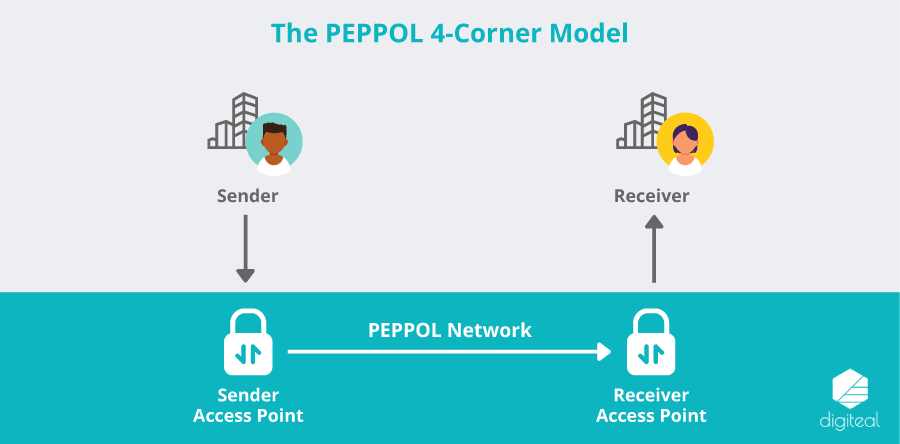
To put it simply, Peppol acts as an address book that organizes the sending of electronic documents (invoices, credit notes, delivery notes, purchase orders…) from one machine to another in a very secure and standardized way. This means Peppol offers a wide range of supported document types, going far beyond e-invoices.

Peppol and mandatory structured electronic invoicing in B2B from 2026

In Belgium, the Royal Decree of March 9, 2022, mandates the use of electronic invoicing for most public contracts and concession agreements via the Peppol platform.

As of January 1, 2026, all Belgian VAT-registered B2B businesses will be required to use structured electronic invoices for all their commercial transactions.

The obligation to use electronic invoicing through Peppol does not apply to goods or services intended for consumers (B2C).

The Belgian government has selected the European Peppol network to standardize invoice exchanges. The Federal Public Service (FPS) Finance, FPS Economy, and sector associations are running an information campaign to prepare and support businesses during this transition.

Who uses Peppol?

Any private organization or public authority looking to improve its money collection or accounting processes can use Peppol.

In Belgium, the government and its suppliers were the first to use the Peppol standard, now mandatory in most B2G transactions. The private sector is also following this trend by gradually adopting the Peppol network for its exchanges. From January 1 2026, the use of Peppol for invoicing between all VAT-registered businesses (B2B) will become the norm.

Why should I use Peppol?

  • As an invoice sender, you should use Peppol to reduce your operational costs (mail stamp, manual treatment linked to paper or email distribution, errors) and integrate your invoice into your supplier’s approval flow more quickly.
  • As an invoice receiver, you should use Peppol to reduce your costs related to the collection of all your supplier invoices, their encoding in your accounting software, etc.

Which countries use Peppol?

In 2025, the Peppol standard is used and available in 37 different countries. In Europe, these include Belgium, France, Germany, the Netherlands, the United Kingdom, Poland, Portugal, Greece, Norway, Finland or again from Iceland. Outside Europe, Peppol can be used in Canada, Japan, Australia, Mexico or Singapore.

In which situations is it mandatory to use Peppol?

In Belgium, any company willing to send an invoice to a public authority (B2G) must send its invoices via the Peppol network. 

Furthermore, the Belgian government has decided to make the use of Peppol mandatory for B2B transactions starting January 1 2026.

Peppol and Mercurius in Belgium

Mercurius is the Peppol Access Point of the Belgian public authority. On top of Peppol, Mercurius provides a centralized platform, which acts an electronic mail room that securely receives and redistributes official documents exchanged with public administrations.

How to connect to Peppol?

If you need to send an invoice to the Belgian government very rarely , you can encode it manually on the Mercurius portal. However, the most efficient way is that your invoicing software has already chosen a Peppol Access Point. As a certified Access Point, Digiteal is already integrated in several software editors.

Is Peppol electronic invoicing free?

To use electronic invoicing, you need to generate invoices electronically, send them through the Peppol network, and be able to receive them from the network.

Invoice generation is done through invoicing software. Some solutions are free, but most require a subscription.

These software solutions typically integrate connectivity to Peppol, which may have additional costs depending on the pricing model of the software provider.

What is a Peppol ID?

A Peppol ID is a Peppol identifier. To register your company in the Peppol Directory, a unique Peppol ID will be created.

A Peppol ID is a specific number composed of:

  1. A prefix  with the type of identifier (ex: 0208 for Crossroads Bank for Enterprises Company Numbers in Belgium, 9925 for VAT number in Belgium, 9938 for VAT number in Luxemburg)
  2. The identifier value (the vat number of the company for example)

Let’s take Digiteal as an example:

The Crossroads Bank for Enterprises company number is 0630.675.588.
Its VAT number is BE0630675588.
Based on that, Digiteal can use the following Peppol IDs: 0208:0630675588 and 9925:be0630675588.

Since multiple identifiers can be used to represent a single company, it is better to register all of them so that the company can be more easily found in Peppol. It is also useful to try alternative identifiers for companies when you wish to send an invoice to your client. They might be registered through their VAT number but they might also only be registered through their company number.

How to obtain a Peppol ID?

Your Peppol ID can be obtained from a recognized Peppol Access Point. Once you have found your Peppol Access Point, it will register you with the platform and provide you with a Peppol ID.

How to send and receive electronic invoices through Peppol?

To streamline your B2B invoice exchanges, the most effective solution is to use invoicing software compatible with the Peppol network. This software connects to Peppol through a secure access point, such as the one provided by Digiteal.

As a user, the connection to Peppol remains entirely invisible to you: once your software is linked to Peppol, invoice transmission and reception happen seamlessly and automatically, without requiring any technical intervention on your part. You can send sales invoices and receive purchase invoices directly within your accounting software, just as you normally would.

If your supplier has not yet adopted structured electronic invoicing, feel free to suggest they reach out to Digiteal to facilitate their transition.

For occasional invoice submissions to public administrations, using the government platform Mercurius’ messaging system can be a convenient alternative.


Peppol Directory: How to find companies registered on Peppol

There is a technical directory that ensures document routing. This system is decentralized and operates based on a DNS, known as the SML (Service Metadata Locator). The SML provides access to decentralized Peppol directories called SMPs (Service Metadata Publishers). Searches within this system can only be performed using a Peppol identifier.

The most well-known directory is the Peppol Directory, a public registry where you can find information on entities registered on the Peppol network. Searches can be conducted using a Peppol identifier, company name, and other criteria.

Are there government grants or subsidies to support the transition to Peppol e-invoicing?

Two tax measures have been introduced to help SMEs and self-employed professionals reduce the costs associated with technical adaptations and migration to Peppol:

  • Investment deduction: Since January 1, 2025, digital investments benefit from a 20% deduction.
  • Increased expense deduction: From 2024 to 2027, small SMEs and self-employed professionals using subscription-based invoicing software can apply a 120% increased deduction. However, note that the additional cost related to electronic invoicing must be clearly itemized on the invoice to qualify!

We encourage you to check with the Federal Public Service Finance (SPF Finances) for available support measures.

Conclusion

Electronic invoicing via Peppol will increasingly become the norm in the near future. Both public and private organizations will benefit from cost and time savings, leading to greater efficiency.

Would you like to use Peppol? Get started quickly and easily with Digiteal, a recognized Peppol access point and an active member of Belgium’s “e-Invoicing Business Expert Group” within the VBO-FEB.