COMPANY
Digiteal SA
BE 0630675588
LEI 9845000A44AB9CA60605
Rue Emile Francqui 6/9
1435 Mont-Saint-Guibert
Belgium
ABOUT DIGITEAL

A “Pay by Link” transaction involves a business sending a digital link to a customer. This link directs the customers to a payment page, where they can complete their purchase securely after choosing their preferred payment method. As mentioned, versatility across digital channels makes this method both straightforward and conducive to omnichannel payment strategies.
Payment links simplify transactions for both sellers and buyers. They support various payment methods, including credit and debit cards, bank transfers, Buy Now Pay Later (BNPL), Google Pay and Apple Pay.
Payment links accelerate the purchasing process. With fewer steps required to complete a transaction, customers enjoy a more efficient and time-saving experience – without requiring any new app installation.
Secure payment gateways are the backbone of “Pay by Link” transactions. These gateways use advanced encryption to protect payment data. That ensures a safe transaction environment.
With the addition of HTTPS to encrypt the data being exchanged and PCI DSS compliance to keep the card data safe, the payment gateways provide the necessary security to perform secure payments.
The ‘Pay by Link’ approach opens up new payment channels as it enables businesses to reach customers across different, complementary platforms.
Real payment links connect to secure gateways run by third-party processors using encryption to safeguard payment data. Make sure that you are connected through an encrypted protocol (https) when performing a payment. The card data will be processed in a secure way and encrypted both when it is transferred and when it is eventually stored in case of tokenization for example.
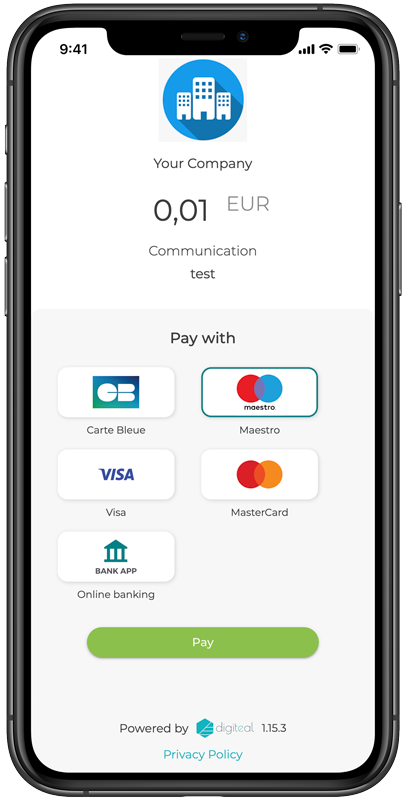
As a PSP and provider of Pay by Link solutions, Digiteal makes the entire process incredibly straightforward and efficient:
With Digiteal, you receive end-to-end support from our team. We ensure that your customers’ future payment experiences are incredibly easy and personalized.
Customizing the payment page
With Digiteal, businesses can not only create payment links but also personalize their payment pages. This way, they can align the payment process with their brand identity, for a cohesive and unique customer experience.
Emails provide an ideal platform for sending payment links, especially for formal and business transactions or when detailed communication is necessary. Email campaigns also enable tracking and analysis of customer engagement with payment links.
Through emails, you can also use a payment button that is using the payment link. The payment button can have extra features like being dynamic depending on the status of the underlying payment. If the email is opened the first time, the button asks the customer to pay. After he paid, if he opens the email a second time, the button will show him when he has already paid to prevent double payments and serve as an extra confirmation that everything is in order…
In either a B2C or B2B context, SMS can be used alone or in combination with other channels to invite customers to make a payment. SMS can be highly effective when used as reminders or as an additional means to collect money, as they show among the highest open rates. When sending a payment link in an SMS, be sure to add as much as possible personalized information about the payment to perform to avoid the SMS to be perceived as phishing.
This method is particularly effective for businesses that issue digital invoices or quotations. By embedding a payment link directly into these documents, customers can make payments immediately upon review. This speeds up the payment cycle.
Payment links can also be particularly powerful in social media commerce. This approach is invaluable for merchants aiming to capitalize on the convenience of social media for shopping to reach a broader audience and facilitate instant purchases, right from the platform.
“Pay by Link” stands as a dynamic, indispensable component to boost your money collection strategy. Its security, convenience and adaptability align with evolving B2B & B2C consumer preferences. As digital transactions continue to escalate, the importance and utility of payment links will only increase.
COMPANY
Digiteal SA
BE 0630675588
LEI 9845000A44AB9CA60605
Rue Emile Francqui 6/9
1435 Mont-Saint-Guibert
Belgium
ABOUT DIGITEAL
 SEPA Direct Debit: Everything you need to know
Scroll to top
SEPA Direct Debit: Everything you need to know
Scroll to top