

Marketplace Payment:
Starter Guide

Are you willing to know more about marketplace payments?

Congratulations! You’re about to launch your own marketplace! Between the business plan, the logistics and the financial forecasts, it’s not easy to think of everything and act in time.

Digiteal offers you a “Starter Guide” article dedicated to payments on your own marketplace. There are a number of points to consider if you want to be up to speed…

This article will help you to understand the regulations to be followed, the legal obligations to be applied, and the possible integrations.,… Digiteal can help you get off to a smooth and well-informed start.

Être payé via votre marketplace - Be paid on your marketplace

How to accept payments on a marketplace?

Marketplace Payment Scheme

Digiteal offers a large choice of payment methods: SDD, SCT (SEPA Credit Transfer) and local payment methods.

Our expertise starts from payment collection to automatic payment reconciliation. Our marketplace payment services are guaranteed at the best price and, above all, at no additional cost: so take advantage!

1Pay In:

This phase involves managing incoming payments, i.e. from buyers to the marketplace.

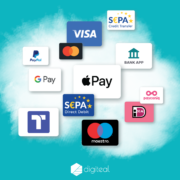
More and more diverse payment solutions are being offered to customers to best meet their needs and requirements. Here are a few examples of how you can integrate them into your payment options:

  • Payment cards (Visa, Mastercard,..)
  • APM (iDEAlL, SEPA,..)
  • Wallets (PayPal, Apple Pay, Google Pay,..)
  • Open Banking (AIS/PIS)
  • Buy Now Pay Later (Terms.Tech,..)
Pa

2Refunds & disputes management:

Return orders are very common on marketplaces, and you need to be informed and ready to act quickly, or risk losing credibility and customer satisfaction.

There are two different types: return (and therefore refund) or exchange

The reasons for a return request can be varied: size problem, wrong product sent, damaged product, etc.

3Pay Out :

This stage consists of transferring funds from the marketplace to the various sellers, after deducting the marketplace commission.

What are the dedicated payment solutions for marketplaces offered by Digiteal?

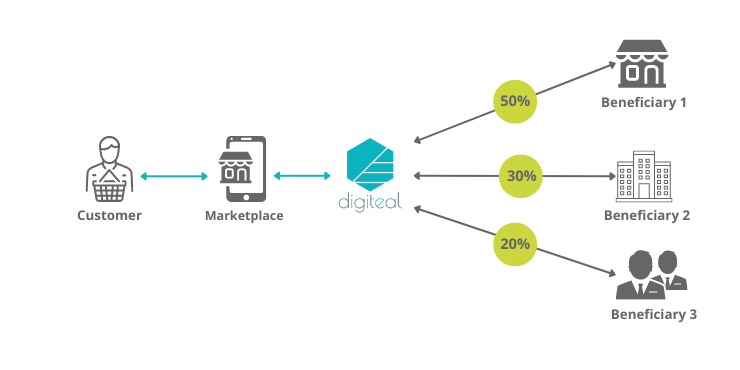
  • SPLIT PAYMENT: Split Payment on a marketplace offers the possibility of splitting/dividing a payment in order to correctly redistribute profits to the various parties according to pre-established percentages.
  • BUY NOW PAY LATER:  With the participation of Terms.Tech, Digiteal offers an alternative for B2B marketplaces: payment by installments, better known as BNPL.

What are the legal obligations regarding marketplace payments?

Tax Management

Tax requirements for marketplaces can be overwhelming, as they vary from country to country.

However, marketplaces are now responsible for collecting VAT and sales taxes in many countries. Tax compliance is a fundamental requirement for global sales.

Fee-based services are then available for calculating taxes in different countries (managing VAT/GST), managing tax accounting, creating monthly tax reports, anticipating tax audits, etc.

Choosing your regulatory system

PDS2 measure requires you to choose your ‘status’. The three options are as follows: 

  • become a payment institution, 
  • become a payment facilitator (PayFac)
  • become an electronic money institution.

Each of these “statuses” has advantages (development opportunities, etc.) and, of course, downsides (restrictions, limitations, etc.).

PSD2 impact:

Since 2015, the Revised Payment Services Directive (PSD2) has aimed to enhance security on payment platforms and improve the customer experience. PSD2 is an improved/updated version of the PSD measure, entered in 2007 by the EU: a payment license is now required when you act as an intermediary between a buyer (the payer) and a seller (the payee), and the seller is located in the EU.

A gray area has been granted to platforms acting as intermediaries on behalf of both buyer and seller, i.e. executing transactions and/or transferring funds.

Know Your Customers (KYC)

To avoid problems such as AML (Anti-Money Laundering), it’s essential to be able to formally identify your customers. In the payment sector, KYC refers to a process put in place by companies to verify and authenticate the identity of their customers.

To achieve this, facial recognition and verification of address and identity documents are measures that need to be implemented.

Know Your Business (KYB)

Similarly to KYC, KYB (Know Your Business) is an identity verification process aimed specifically at companies with which you have a relationship (suppliers, subcontractors, logistics, etc.).

How about risks linked to KYC & KYB?

In today’s digital age, crime is invading our social networks, digital platforms and applications, as well as marketplaces with high commercial potential. Indeed, identity theft scams are widespread.

Criminals register on platforms using false data and act as sellers/buyers to steal customers’ identities. E-commerce accounts urgently need KYC checks to verify the consumer’s real identity when registering.

Digiteal ensures optimal KYC thanks to the measures it has put in place and its status as a Payment Institution certified by the NBB (National Bank of Belgium).

What are the methods for integrating marketplace payments?

API

The best payment solutions offer easy-to-integrate application programming interfaces (APIs). Digiteal, for example, provides a richly documented API that greatly simplifies integration on different platforms, whether these are custom-built or based on pre-existing technologies.

Partners

What’s more, some payment platforms benefit from partnerships with key players in the marketplaces ecosystem to offer simplified integrations to their users. Digiteal, for example, has forged a partnership with Marjory to facilitate these connections.

Pay by link

Finally, sellers who wish can also generate payment links, known as “Pay by Link”, either automatically or manually. These links can then be transmitted to customers to initiate the payment process.

Get more information thanks to our experts