

Teal Organization
What is it about?

Teal Organization

A Teal Organization is a specific type of management founded among other on people and their own responsibilities and abilities. In this article, we are going to tackle topics around Teal management such as his origin, practice, daily use and tips to implement his methodology in your own company.
What is Teal management really about?

Teal management is a working methodology based on cooperation, trust, self-management, and transparency within a professional environment. Its foundation is to simultaneously promote the development of individuals and the collective.

This type of self-managed organization is referred to as “Teal,” named after the color “opale” in French. Unlike more hierarchical organizational types, it isn’t built upon an organizational chart or hierarchy and does not rely on fear or intimidation.

From where comes Teal organization philosophy?

It’s Frédéric Laloux, an expert in international strategy and an independent coach, whom detailed this ideal methodology in his book “Reinventing Organizations” in 2015.

He makes several alarming observations about the functioning of many companies today, noting:

  • A lack of “soul” in large organizations/companies.
  • Profit-seeking being the main concern.
  • A lot of frustrations and demotivation at the human level (HR).
  • A VUCA environment – Volatile, Uncertain, Complex, and Ambiguous.
  • Multiple economic, political, humanitarian crises, etc.
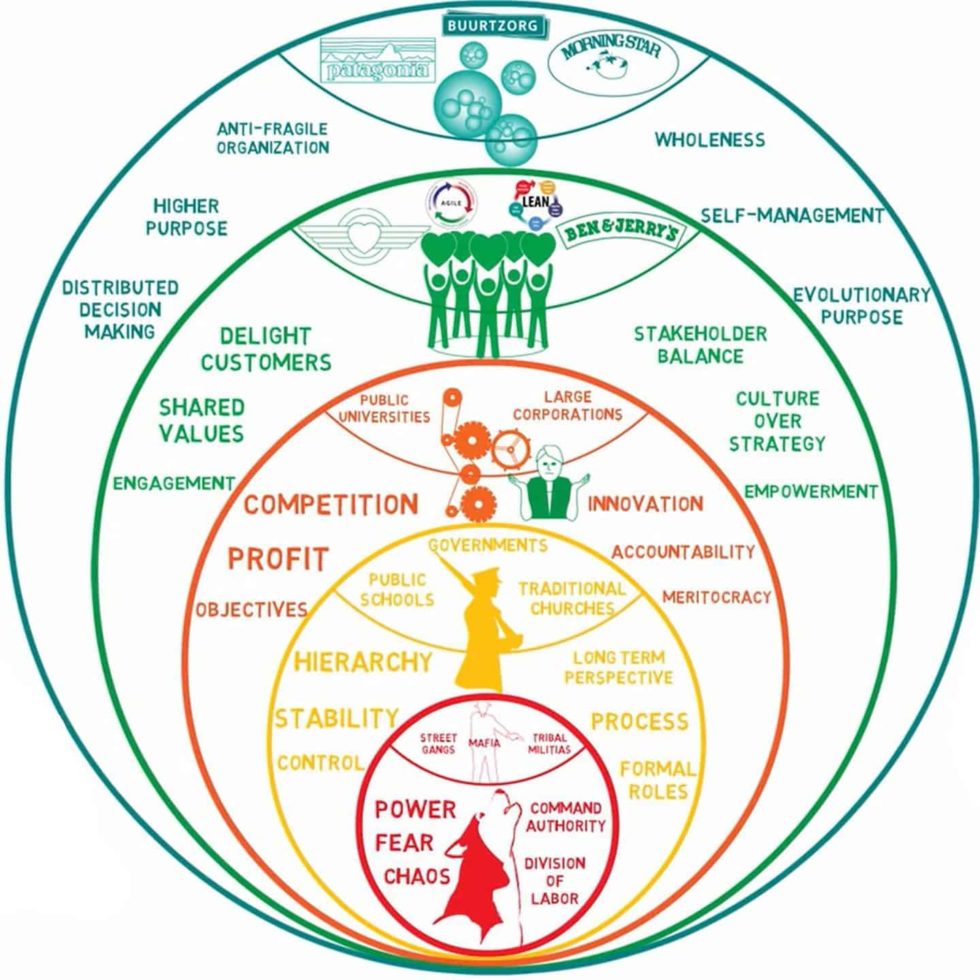
Representation of Teal organization in comparison with traditional management styles

In practice, how does a Teal organization work?

Emphasizing trust, this type of organization is based on three pillars:

  • Evolutionary purpose, which promotes a shared mission and values charter that is collectively embraced and realized. Flexibility and adaptability are essential in a VUCA environment.
  • Wholeness involves acknowledging that a worker has a life outside of work and thus private matters to attend to. Empathy and acceptance are crucial.
  • Self-management implies each individual’s responsibility to manage their tasks, workload, and priorities. There isn’t a strict “boss” or “manager,” only natural leadership arising from seniority and experience. Anyone can initiate a project, but consulting someone more experienced in a specific domain is essential. This encourages collaboration among colleagues and the sharing of knowledge.

How is Teal management applied in daily use?

We can say that a Teal organization is implemented daily by adhering to several principles. In terms of organization, it requires:

  • Mutual trust between employees and employers, among colleagues, etc.
  • A humane and nurturing atmosphere.
  • Teamwork and agility (co-constructed strategy, Jira).
  • Synchronizations for access to project timings and deadlines (via Google Meet, Google Calendar).
  • Transparency and information sharing to make project progress and content accessible (via Trello, Loomio, Google Drive).
  • Sharing and celebration to strengthen relationships among colleagues.
  • Feedback processes occur in “One-to-One” sessions and through self-feedback, involving self-reflection.
  • Governance is designed as sociocracy (RACI, Strategy, Loomio, Board of Directors, General Assembly).

Why did Digiteal adopt Teal management approach?

Cédric Nève, the Digiteal’s founder, tells us more about his vision of a Teal organization:

Even before Digiteal started up, we were attracted by a more participative approach that empowers all employees. So we implemented it right from the start.

We want to work for a company that has a purpose that speaks to us: digitizing processes to reduce waste and time loss. We also want to work with colleagues we can all rely on and who are all involved in making improvements within the company, for our customers and for the planet.

Indeed, this type of management offers numerous advantages:

  • True cohesion, a common dynamic driving the company forward,
  • Less negative stress, increased well-being,
  • Enhanced productivity,
  • High adaptability/flexibility/reactivity to market needs

How to begin to implement Teal organization principles?

Here are 3 tips to start well in your own organization/company:

  • Place people at the center by emphasizing mutual trust, defining the company’s mission and vision collectively, valuing initiative-taking, retrospectives, and recognizing others’ work.
  • Provide access to information by fostering complete transparency.
  • Empower your team: “It’s your role, you’re best suited to decide what’s best.”, “What would you do?” (criticizing isn’t the solution; what’s the suggestion?)

And you?

Are you convinced by this participatory management approach?

Try rethinking your organization in terms of management using the fine example of Digiteal today.

Digiteal

See how we adopted Teal practices in our organization and meet the team here .