Copy to Bookkeeper: bringing accounting document exchange into Peppol

Peppol has become the standard way to exchange electronic invoices between suppliers and buyers. But in practice, the invoice journey often does not stop there: businesses also need to make their incoming and outgoing invoices available to their accountants or bookkeepers. Today, this part of the process is still frequently handled through proprietary APIs, accounting portals, file exports, email or private document exchange networks.

The Peppol Copy to Bookkeeper process addresses this gap by providing a standardized way to exchange accounting copies of billing documents through the Peppol network.

The idea is simple: allow businesses and their software providers to send an unchanged copy of Peppol billing documents to their accountant or bookkeeper through the Peppol network itself, using a standardized process.

For software vendors and Peppol Access Points, this standardized process reduces the need for bilateral integrations. For accounting firms, it provides a more consistent and automated way to receive client documents.

Digiteal currently leads the Belgian Peppol focus group working on third-party scenarios and has coordinated the Copy to Bookkeeper RFC together with Belgian and European Peppol experts.


The technical principle

From a technical perspective, Copy to Bookkeeper introduces an interesting difference compared with normal BIS Billing exchanges.

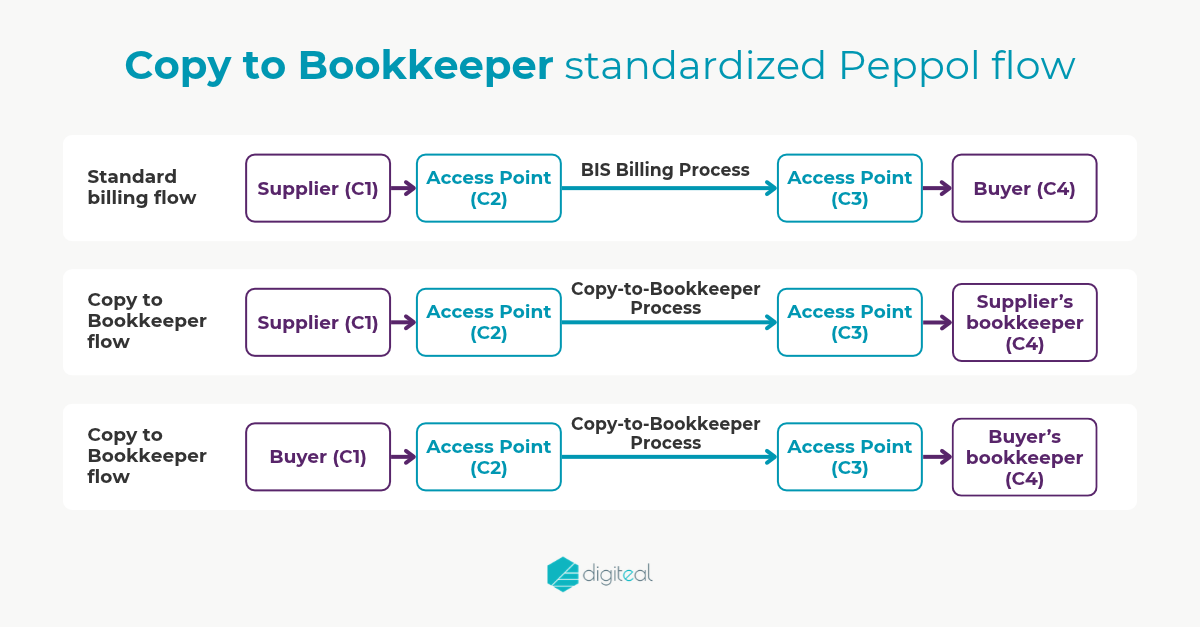
In a standard Peppol billing transaction, the sender and receiver identified in the transport envelope are expected to correspond to the business parties represented inside the document. That makes perfect sense when an invoice moves directly from supplier to customer but it does not work for a copy scenario.

If a buyer receives an invoice and subsequently sends that invoice to its bookkeeper, the buyer becomes the sender of the Peppol message even though the supplier remains the supplier inside the invoice. Likewise, the receiving Peppol participant is now the bookkeeper while the customer inside the invoice remains unchanged.

The Copy to Bookkeeper process relies on two fundamental technical elements:

  1. A dedicated Process Identifier identifies the Copy to Bookkeeper exchange using the process name ‘bookkeeping’
  2. A specific exception to the Peppol ‘Compliance to BIS’ rules allows the sender and receiver identifiers in the SBDH transport envelope to differ from the corresponding EndpointID values inside the business document. This enables the original billing document to be transported unchanged while clearly identifying the exchange as an accounting copy.

More than invoices

Although invoices are the most obvious use case, Copy to Bookkeeper covers a broader range of billing-related documents including invoices, credit notes, self-billing documents and invoice responses, with the relevant role adjustments. This matters because accounting workflows do not consist only of invoices.

By supporting multiple billing-related document types, Copy to Bookkeeper provides a foundation for more complete accounting document exchanges within the Peppol ecosystem rather than introducing another isolated invoice-only mechanism.

Why this matters for software vendors

For ERP vendors, invoicing platforms and accounting software providers, Copy to Bookkeeper introduces a standardized mechanism that significantly simplifies interoperability between business and accounting applications.

Today, a software vendor wanting to transfer documents to accounting environments may have to support several proprietary APIs or document exchange mechanisms. A standardized Peppol process changes the model. Instead of asking ‘How do I integrate with accounting platform A, B or C?’, the question can increasingly become: ‘Can the accounting environment receive this Peppol process?’. That opens the door to a much more scalable architecture.

A software vendor could implement one standardized mechanism and make it available to many accounting environments, provided the relevant access points and receiving applications support the process. This also gives vendors the opportunity to offer a better user experience. For example, a business could configure its accountant once and have incoming and outgoing billing documents automatically forwarded without requiring manual downloads, uploads or email exchanges.

What do accountants and bookkeepers gain?

For accounting firms, the benefit is straightforward: documents can arrive automatically through a standardized network. Instead of asking each customer which ERP they use, which portal they need to connect to or which export format is available, an accounting environment could receive documents through Peppol. This can reduce manual document collection and lower the dependency on proprietary integrations. It can also make onboarding new customers easier.

If both sides support the process, the accounting firm no longer needs a bespoke integration with every invoicing solution used by its clients. For larger accounting platforms serving thousands of businesses, that interoperability benefit can become significant.

Why not just send the invoice twice?

It is important to distinguish Copy to Bookkeeper from simply issuing or sending the same invoice twice.

The accounting copy is not another commercial invoice sent to another buyer; it is a copy of an existing business document transported for a different purpose.

That is precisely why Copy to Bookkeeper uses a separate Peppol process. Its dedicated Process Identifier makes the intent explicit and allows software and access points to distinguish an accounting copy from the normal billing flow. It also avoids changing the invoice itself merely to make the transport possible.

From standardization to implementation

With the Copy to Bookkeeper process standardized, software vendors and Peppol Access Points can begin implementing the necessary capabilities to support accounting document exchanges through Peppol.

Important implementation questions include:

  • How will customers configure their bookkeeper?
  • How will the receiving Peppol participant be identified?
  • How will the dedicated process be advertised in the SMP?
  • How will outgoing and incoming copies be triggered?
  • How will duplicate processing be avoided?
  • How will copies be distinguished from normal billing transactions?
  • How will accounting applications route the received document to the correct customer file?

These questions involve the complete chain from business software to Access Point to receiving accounting applications. This is why cooperation between software vendors and Peppol Service Providers will be critical to adoption. An implementation guide is in the works to answer all of those questions.

How Digiteal can help

Digiteal leads the Belgian Peppol focus group working on third-party scenarios and plays a leading role in the development and standardization of the Copy to Bookkeeper process, together with Belgian and European Peppol experts. This involvement gives Digiteal first-hand expertise in the business requirements, technical architecture and implementation principles of Copy to Bookkeeper.
  • For software vendors and Peppol Access Points looking to implement Copy to Bookkeeper, Digiteal can help assess the impact on existing Peppol flows, understand the technical requirements, adapt their infrastructure and integrate the standardized process into their solutions.

  • Whether you are an ERP vendor, an accounting software provider or a Peppol Access Point, Digiteal can support your adoption of Copy to Bookkeeper and help you take advantage of this new interoperability capability.

  • For the Peppol ecosystem, Copy to Bookkeeper represents something broader than a new document route: it is an opportunity to replace another layer of proprietary integrations with interoperable infrastructure and to extend the value of Peppol beyond the traditional supplier-to-buyer exchange.