All-in-one Peppol access point
Full access to the Peppol network for both B2G and B2B exchanges.


Peppol stands for Pan-European Public Procurement On-Line. It was initially established by the European Commission to generalize electronic invoicing and e-procurement.
Peppol functions like an address book combined with a secure transport network that enables the standardized and traceable transmission of electronic documents (invoices, credit notes, purchase orders, etc.) from one system to another. The network is not limited to e-invoices only: it supports multiple types of documents.
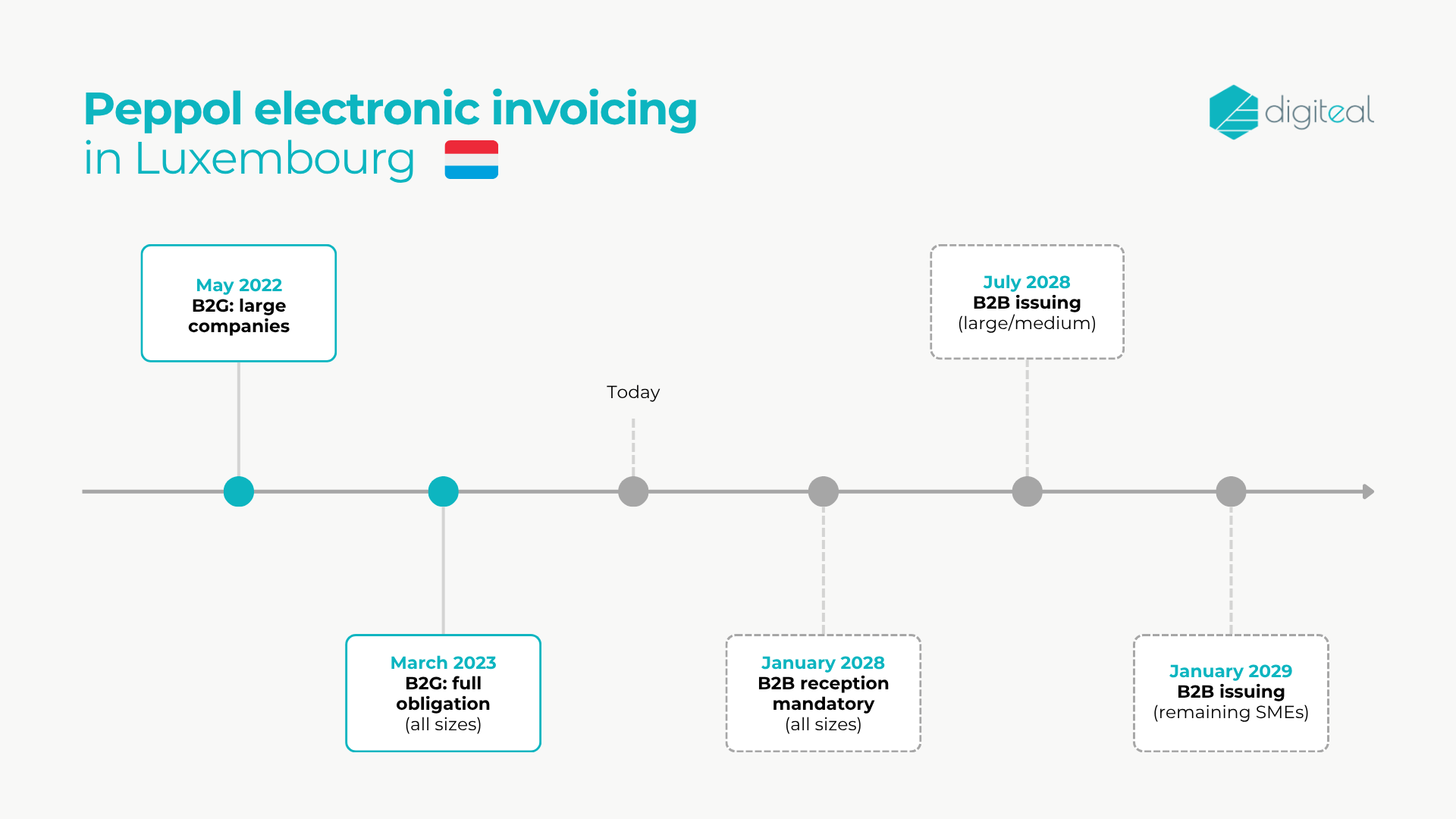
Luxembourg regulations cover public procurement contracts and concession contracts. The law requires that electronic invoices be issued and transmitted to government bodies and other public organisations through approved channels only: via the Peppol network (the standard route) or, as a fallback, through the electronic forms available on MyGuichet.lu.
The obligation was rolled out in phases between May 2022 and March 2023 depending on company size, with the final phase bringing small businesses on board on 18 March 2023. Since that date, all public sector suppliers must issue compliant invoices electronically through the Peppol network.
Public sector bodies, for their part, must be able to receive and process these electronic invoices. The State Information Technology Centre (CTIE) provides a shared access point for public entities that do not have their own infrastructure.
Peppol usage in Luxembourg follows the Peppol BIS Billing v3 standard, with no country-specific requirements. The full list of country-specific requirements is available in OpenPeppol’s PASR documentation (Luxembourg is not included, as no specific requirements apply).
On 17 July 2026, the Luxembourg government approved a draft law extending mandatory e-invoicing beyond B2G, to cover domestic B2B transactions (where both the supplier and the client are based in Luxembourg). The law still needs to go through parliament, but the direction and timeline are now clear.
According to the Chamber of Commerce, the rollout will happen in stages:
This reform builds on the Peppol infrastructure already used for B2G, and on the European EN 16931 standard. It also fits within the EU’s ViDA (VAT in the Digital Age) initiative. Cross-border B2B and B2C transactions are not covered at this stage.
The B2G obligation in place since 2023 was really just a first step: Luxembourg is following a path similar to Belgium’s, which made Peppol mandatory for B2B back in January 2026.
Companies and software vendors are strongly encouraged to start preparing now: the technical building blocks and processes for B2B will largely be the same as those already used for B2G.
Peppol is the network chosen for the automated reception of electronic invoices by all public bodies (ministries, government agencies, municipalities, and so on). A Grand-Ducal regulation, passed in 2021, formally established Peppol as the common delivery network for electronic invoices to the Luxembourg public sector. All PSBs (public sector bodies) must therefore be reachable on Peppol to receive B2G invoices, either through their own access point or via the CTIE’s shared access point. Bodies connected through the CTIE are automatically listed in the Peppol directory, making it easier for their suppliers to identify them.
Any company invoicing a Luxembourg public sector body is legally required to issue compliant electronic invoices and transmit them via the Peppol network. This obligation applies to all invoices under public procurement contracts, with no minimum amount and no sector distinction, except for a few narrowly defined cases set out in law. In practice, any company working with the Luxembourg public sector must be equipped to send invoices in structured format (XML) over Peppol.
Outside the public sector, using Peppol is still optional today, but will become mandatory from 2028 for domestic B2B exchanges (see timeline above). Until then, nothing stops two private companies from exchanging Peppol invoices voluntarily, for example to streamline accounting. The network, originally built for B2G, natively supports B2B exchanges too, which means the private sector can already rely on the same infrastructure that will soon become the standard.
Even where there is no legal obligation beyond B2G, adopting Peppol brings real advantages for B2B companies. Here is an overview:
These benefits explain why many companies choose to adopt Peppol voluntarily, well ahead of any legal requirement.
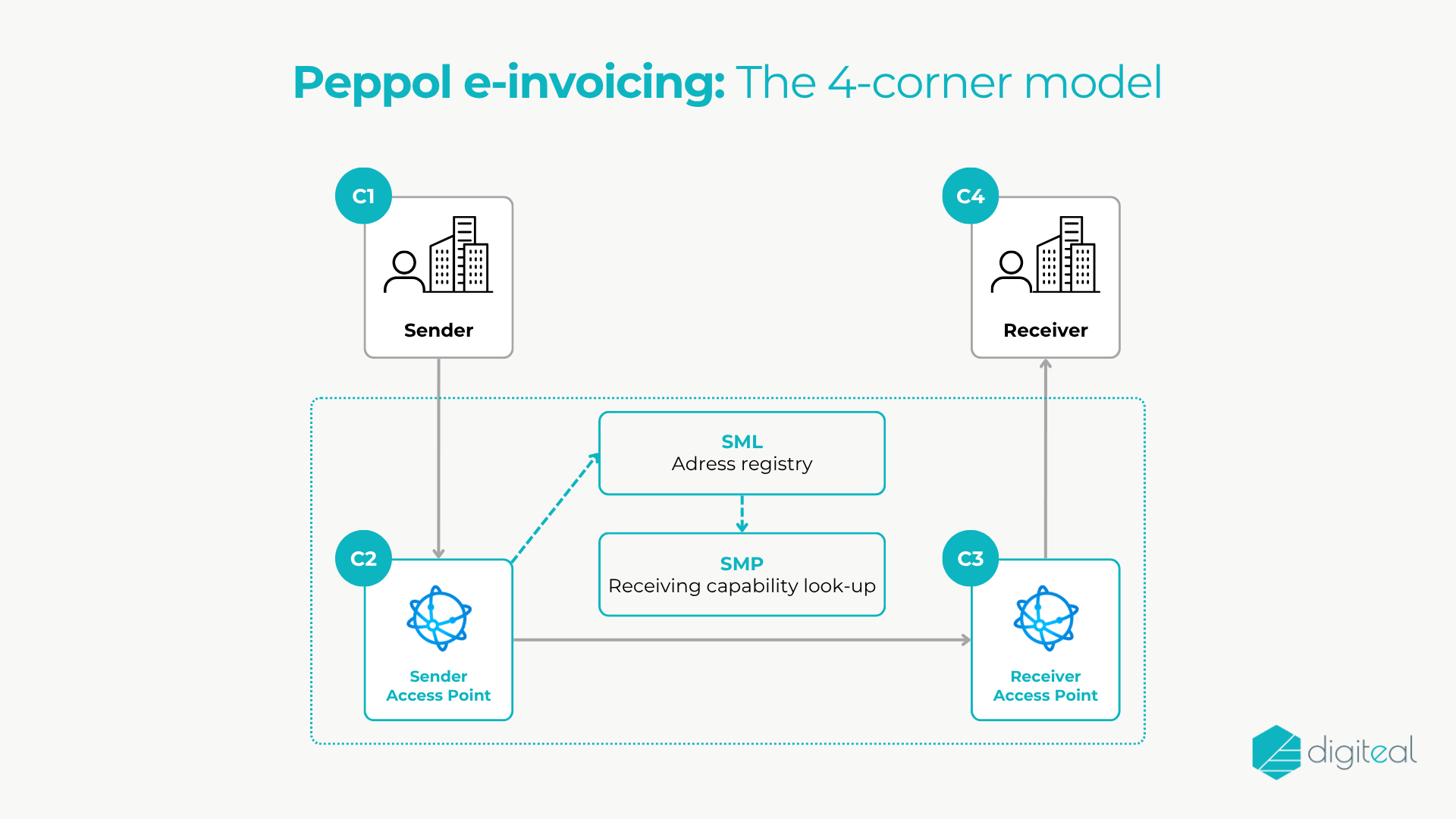
The Peppol network operates the same way in every country and is built on what is known as the four-corner model.
This model involves four parties in every document exchange:
In other words, each company, whether sending or receiving, connects to the network through a certified access point of its choice. The two access points handle the transmission of the document from sender to the correct recipient across the network.
The access point’s role is routing. When a sender issues an invoice, their access point queries the Peppol directory to confirm that the recipient is registered and reachable, and to verify that they are able to receive the document type being sent. The invoice is then forwarded to the recipient’s designated access point, from which the recipient retrieves it.
All of this happens transparently and with a high level of security. This decentralised model guarantees interoperability on three levels: technical, through the four-corner model structuring exchanges between access points; semantic and syntactic, through a single document format (UBL / BIS) understood by all participants; and dynamic, through the global directory (SML / SMP) that allows any sender to locate and address any recipient in real time. As long as each participant is connected to a Peppol network access point, they can exchange documents with one another.
Companies have two main options for transmitting an electronic invoice to the Luxembourg public sector: sending via Peppol or sending via MyGuichet.lu. For regular, professional use, connecting via Peppol is by far the more efficient route. MyGuichet works well as a practical fallback for very small organisations or businesses in a transitional phase, but it cannot be automated at scale.
This is the smoothest and most scalable approach if you regularly send B2G invoices or want to get ahead of a future B2B obligation.
In practice, it means connecting your invoicing software or ERP to a Peppol access point (a certified provider such as Digiteal) so you can send invoices in a single click. Once the integration is in place, your software automatically sends compliant invoices to the access point, which routes them to the recipient.
As an alternative, a large organisation may choose to run its own Peppol access point, but this route is generally reserved for entities with significant IT resources, as it requires managing and maintaining the entire infrastructure in-house, along with the expertise and costs that entails.
If your software is not yet connected to Peppol and you only have a small number of invoices to send to public authorities, Luxembourg provides two online forms on MyGuichet.lu:
These two MyGuichet forms are the “non-automated” alternative technical solutions provided for in the regulations, intended for organisations that do not yet have Peppol access.
The logic for sending and receiving documents on Peppol is the same whether you are invoicing the public sector (B2G) or another business (B2B).
On the receiving side, the process mirrors this exactly: if you are connected to Peppol, incoming invoices will reach you through the same automated flow. Your access point will receive invoices sent to your Peppol identifier and forward them to your software, which can integrate them automatically into your accounting system (or your internal approval workflow). This applies equally to B2G invoices (received by public entities) and any B2B invoices received via the network.
For the public sector: if you are not yet connected to the network, the MyGuichet solution described earlier remains the alternative, either by entering invoices manually or by importing XML files through the online forms. These manual options allow you to meet your legal obligation while you work towards a more complete integration.
Finally, once an invoice has been transmitted, the sender receives a technical acknowledgement confirming successful delivery to the access point. If an invoice is rejected for non-compliance via an MLR (Message Level Response), the process differs depending on the context: in B2G, the ministry allows suppliers to obtain the reason for rejection so they can correct and resubmit the document; in B2B, it is the recipient’s access point that communicates the reason for rejection, provided the recipient registered with the capability to receive that document type.
Moving to electronic invoicing does not remove your archiving obligations, far from it. In Luxembourg, accounting documents must generally be retained for a long period, often 10 years, depending on the document type and the applicable legal framework.
For example, Article 16 of the Commercial Code requires merchants to retain their corporate documents for 10 years from the close of the financial year. Invoices (including electronic ones) fall under this same category of accounting records.
Just as with paper invoices, you will need an archiving solution for your e-invoices. This can be provided by your invoicing software (many offer secure storage for both sent and received invoices) or through a certified electronic archiving system.
Make sure your Peppol invoice XML files are kept intact for at least 10 years, with the necessary guarantees of authenticity and integrity. In the event of a tax inspection or audit, you must be able to present these electronic invoices in a readable form, just as you would (or would have) with paper invoices.
In Luxembourg, Peppol has been the mandatory invoicing channel for B2G since 18 March 2023. On the B2B side, the timeline is now known: mandatory reception from 1 January 2028, followed by a phased rollout of mandatory issuing through to 1 January 2029 for all companies. So if you’re a software integrator or a B2B company, the best strategy is clear: the sooner you connect, the better.
By getting ahead of it, you modernize your processes and align yourself with what will soon be the norm, especially since most of the implementation work (formats, IDs, automation, archiving…) is exactly the same between today’s B2G obligation and the upcoming B2B one.
In short, whether your business deals with the public sector or not, structured e-invoicing through the Peppol network is an opportunity to gain efficiency and stay compliant. Best to get ready now, so you can approach the 2028-2029 deadlines with confidence.
As a certified Peppol access point since 2021, Digiteal supports businesses, public administrations, and software publishers in connecting to the Peppol network, in Luxembourg and across Europe.
Whether you are a business invoicing public authorities, a B2B player looking to get ahead of regulatory changes, or a software publisher in need of a reliable Peppol integration, Digiteal supports you from start to finish.
COMPANY
Digiteal SA
BE 0630675588
LEI 9845000A44AB9CA60605
Rue Emile Francqui 6/9
1435 Mont-Saint-Guibert
Belgium
ABOUT DIGITEAL

 Verification of Payee (VoP): Everything you need to know
Scroll to top
Verification of Payee (VoP): Everything you need to know
Scroll to top